Saturday, August 18, 2012

Apple’s plan to take over TV: Cloud-based DVR, iOS interface, social sharing

Apple’s (AAPL) plan to take over our living rooms starts with a cloud-based DVR service, social sharing features and an icon-based user interface, The Wall Street Journal reports. Following up the paper’s earlier report, which reiterated news from earlier this year surrounding Apple’s negotiations with television service providers, the Journal cited multiple unnamed sources in claiming Apple has big plans for the live TV service it is currently pitching alongside its vision of the next-generation Apple TV set-top box. Among the key features are global cloud-based DVR service, which would allow users to watch any show on-demand at any time once it has begun airing; a user interface similar to the one seen on the company’s iPhone and iPad; and social features that would allow users to share TV shows through services like Twitter. The Journal also reiterated that Apple is currently negotiating directly with content owners and not just with service providers.

X-S1 Digital Camera +8GB Card+Case


SHOOTING
12 megapixel 2/3-inch EXR CMOS Sensor
Only the EXR CMOS sensor can intelligently switch between three original technologies depending on the scene and always capture the moment in exquisite detail and with impressive image quality.
High Speed Auto Focus
Faster response for fleeting moments. 
Fast 0.18sec. auto focus, 0.01sec. near-instant shutter time lag and the fast 0.6sec*. camera startup!
High Speed Shooting Functions
Never misses the decisive moment capturing 7fps at full resolution (12 megapixels) for 8 continuous frames.

IMAGING


EXR Processor
Working in tandem with the 2/3-inch EXR CMOS sensor, the EXR Processor achieves a new level of performance.
 
In-camera RAW Converter
The X-S1's built-in RAW data converter lets you view and edit your results without the need for your PC.
 
Powerful Built-in Auto Bracketing Functions
Empowering you with a choice of 4 different auto bracketing functions (AE, ISO Sensitivity, Dynamic Range and Film Simulation), the X-S1 lets you experience the wide world of photographic expression.
 
PRODUCT SPECIFICATIONS


3.0-inch Tilting LCD Screen
Compose shots at even the most difficult angles with this useful tilting 460,000 dots of resolution, LCD screen.
Motion Panorama 360 - Photo Gallery Quality
 
Just sweep the camera right-left or up-down to shoot giant panoramas up to 360°. When you view the panorama playing back on your camera or personal computer, you can enjoy a seamless panorama image with both ends stitched together to create a “cylinder” view.
 
Sample Image 1
 
Sample Image 2


Fujifilm X-S1 Digital Camera +8GB Card+Case specifications
SKU     FU527EL49ZGSZAME
Model     X-S1
Size (L x W x H cm)     14.9 x 13.5 x 10.7
Weight (kg)     0.91
Color     Black
Optical Zoom     26.0
Megapixels     12.0
Product warranty     1 year Mizado warranty guaranteed

Review: Razer Naga (2012 Edition)

One of Razer's most iconic products gets a few handy additions as part of its latest version.

Gaming mice used to be simple beasts, but in recent years we have seen increasing specialisation in designs. A mouse focused on first person shooters is significantly different from one focuses at real time strategy players, for example. These different designs combine everything from specialised sensors to the type and arrangement of buttons, each aimed at delivering the best control scheme for a single genre.
Razer’s Naga was one of the first mice to launch with a focus firmly on MMO players, and did so with its near ludicrous number of side buttons. On the left side of the mouse sit twelve such buttons, arranged in a 3 x 4 grid. These are designed to allow for the huge number of abilities used in games like World of Warcraft, and can be a boon for players who are serious about their MMOs.
To make the most out of the Naga one needs to spend a decent chunk of time training with it. With so many buttons arranged in such a small space it takes some time getting used to hitting the correct ones. It is tricky and a sometime uncomfortable learning curve, but once using the Naga clicks it is hard to go back to less featured mice. In fact, the biggest competition to the Naga, Corsair’s M90 mouse has a similarly large amount of buttons and accompanying learning curve, with the major difference when choosing between the two a question of which button layout is preferred.
There have been a few iterations of the basic Naga design released over the years, and it is the latest version that we have been playing around with. This 2012 edition brings a couple of changes to the basic design, adding two buttons behind the scroll wheel and shipping with three interchangeable side panels.
These side panels click onto the right side of the mouse and are held in place by magnets. They offer three distinct types of grip, ranging from one with an extra wide finger rest to one designed for use with a ‘claw grip’ in which the mouse is held between thumb and little finger. Normally we’d dismiss these grips as a gimmick, but they work incredibly well with a mouse of the Naga’s design.
Because the array of 12 buttons requires quite precise thumbwork, we find that our grip on the Naga is different to what we use on normal gaming mice. In our case the wider finger rest grip made the experience a lot more comfortable than it was on the original model Naga, a noticeable change to a mouse design that we have used extensively over recent years.
While the major selling point of the Naga is still going to be whether or not you need 12 thumb buttons, the changes made with the 2012 edition make it the most compelling version to date. Not only is the use of the new cloud-based synapse software quite handy, but the ability to tailor the mouse to our hands via the side panels is excellent, and provides a noticeable improvement over the previous generations of the Naga. One of the best MMO mice just got better.

Mad Catz and Razer unveil keyboards for hardcore gamers

Take your PC gaming to ridiculously high levels of awesome with these touchscreen-equipped keyboards

Day two of Gamescom is well underway, and while everyone is getting stuck into the best upcoming titles, Razer and Mad Catz are showing off the kit you'll be using to play them. Warning: these aren't for the casual gamer.

Mad Catz S.T.R.I.K.E. 7

The Mad Catz S.T.R.I.K.E. 7 is about as fully customisable as a keyboard could be – you can dismantle its five separate sections – including a touchscreen pad – and put them back together whichever way you fancy.
The S.T.R.I.K.E. 7's touchscreen can also detect gesture controls for the the full Starship Enterprise experience, while the keyboard even comes with some comfy wrist wrests for those long gaming sessions
Of course, all of this has to come at a price, and at an eye-watering $US 299, it's certainly not coming in cheap. It is, however, available right now.

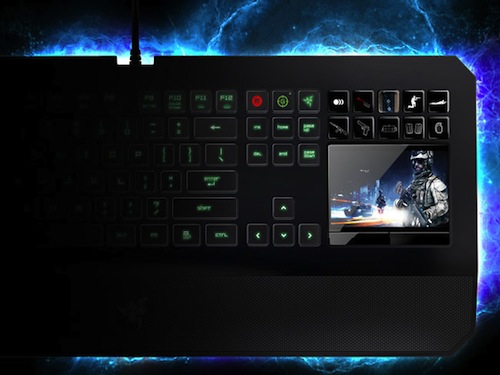
Razer Deathstalker Ultimate

The Razer Deathstalker Ultimate is a little more streamlined than the Mad Catz – but just as packed out with features. For one, its touchscreen is actually integrated onboard, and can be used to control your web browser, Facebook and other widgets. Not to mention any number of in-game apps we'll surely be seeing.
The Deathstalker Ultimate also packs ten fully-customisable LCD keys – you can even change the tiny display on each key. Expect to see game designers creating their own features and designs for the keys that will appear during gameplay.
Even for the non-gamer, the DeathStalker Ultimate is a cool piece of kit, and we can't wait to see what users and developers will do with it. It'll be launching in September for $US 250.